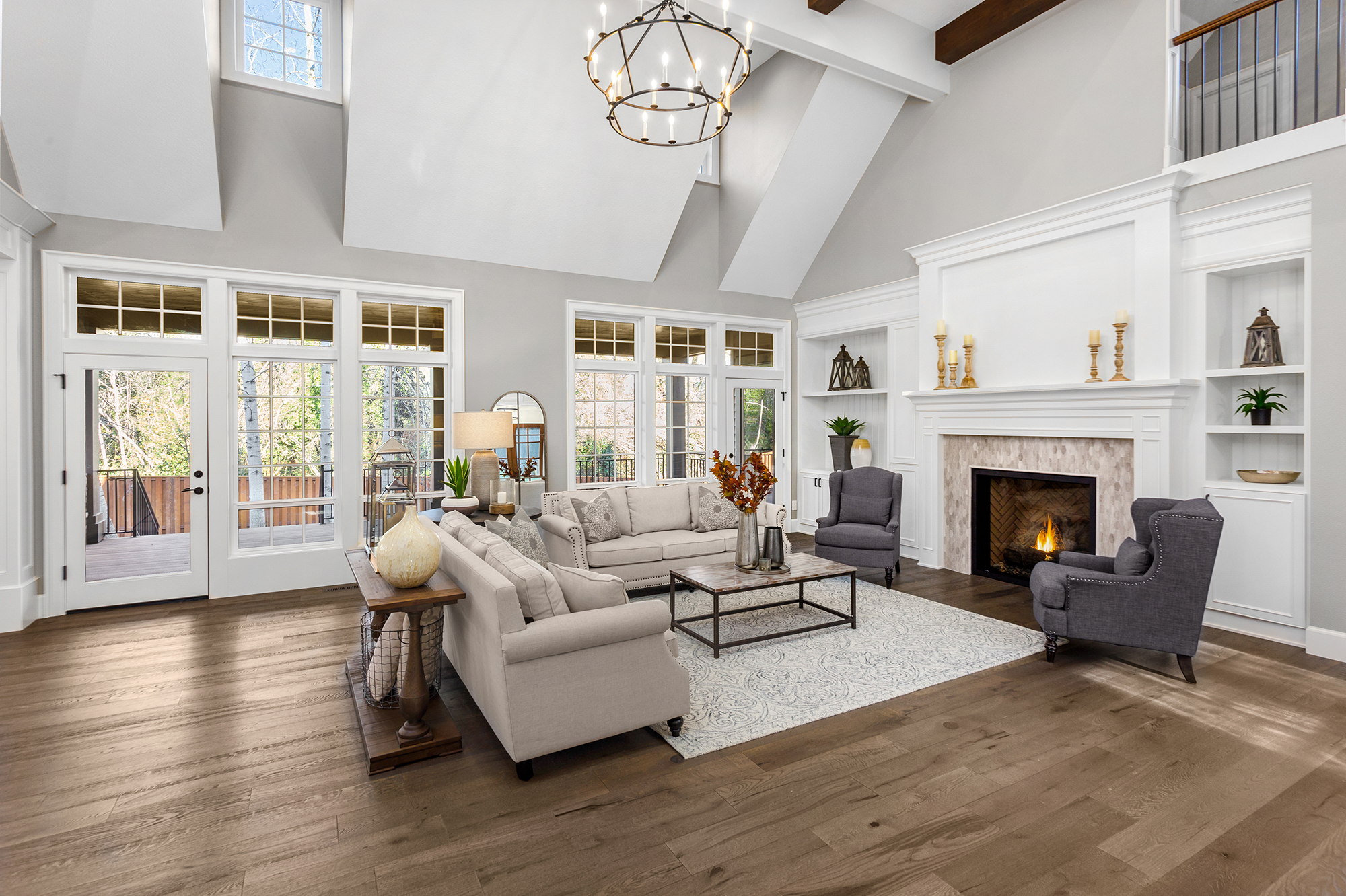
Most flooring specs are written around a single set of interior conditions and left there. A lakefront build does not get that luxury. Proximity to open water changes the relative humidity a home experiences across the year in ways that inland properties simply do not deal with, and wood responds to that change whether or not anyone planned for it. The result is that a floor spec written the same way for a lakefront home as for a home three miles inland is already missing a variable that matters.
The detail most specs skip is equilibrium moisture content, or EMC, the point at which a piece of wood stops gaining or losing moisture because it has matched the surrounding air. A lakefront home near open water typically sees a wider swing in ambient humidity between summer and winter than an inland home does, which means the flooring installed there needs to be acclimated to a target EMC that reflects that wider range, not a generic interior average.
Why Dew Point Matters More Near Water
Homes near open water are also more prone to dew point related condensation at the subfloor level, particularly in walkout lower levels or homes built close to grade near the shoreline. When warm humid air meets a cooler subfloor or slab, moisture can condense at that boundary even when the room above feels perfectly dry, and this is a mechanism that has nothing to do with visible humidity in the air and everything to do with temperature differential.
This is why a proper vapor retarder at the subfloor, sized correctly for the specific installation method, matters more on a lakefront build than it does on a typical inland project. Skipping this step because the room looks and feels dry is one of the more common ways a lakefront floor ends up with cupping or movement within the first year, long after everyone assumed the acclimation period had done its job.
Dimensional Movement Is Not The Same Across Widths
Wider planks move more than narrower ones in absolute terms, even though the percentage of expansion and contraction stays roughly consistent across widths. A five inch board and a nine inch board made from the same species and moisture content will show noticeably different amounts of physical movement across a seasonal humidity swing, which means wide plank specifications near water benefit from a slightly more conservative approach to expansion gaps than the same species would need inland.
This is a calculation, not a guess, and it is worth asking a manufacturer directly how they account for plank width when recommending expansion allowances for a lakefront project, since a generic gap recommendation that works fine inland can be genuinely insufficient closer to open water.
Engineered Construction Earns Its Place Here
Engineered construction, with its cross layered core countering the natural movement of a solid wood wear layer, was built to solve exactly this kind of seasonal stress, which is part of why it has become close to standard on lakefront and waterfront builds specifically. Solid wood still has its place on plenty of inland projects, but the added stability of an engineered core is one of the more genuinely useful technical arguments for it, rather than just a manufacturing preference.
Builders working near water should ask directly about core construction, ply count, and how a manufacturer's engineered product is tested for movement, since this detail affects long term performance far more than most of the aesthetic choices made earlier in the process.
Specifying With The Right Conditions In Mind
At Urban Plank, we work with builders and architects to account for site specific conditions, including proximity to water, when recommending acclimation targets, expansion allowances, and construction type for a project.
If you are planning a lakefront build across Holland, Grand Rapids, Grand Haven, Traverse City, and Harbor Springs, MI, our team can walk through the specification details that matter most for your site before material is ordered. Explore European oak flooring manufactured for Grand Haven builds or contact us to talk through your project, with full support available from Holland, MI.